+91-74988 12711
smile@sanghavidentalclinic.com
-
-
Fulchand House, Canal Rd, Amrai
Baramati, Maharashtra
Contact Info
-
Address
Fulchand House, Canal Rd, Amrai, Baramati, Maharashtra 413102
-
Phone
-
Email
© Sanghavi Dental Clinic & Implant Centre , All Rights Reserved. Powered By Praxis360
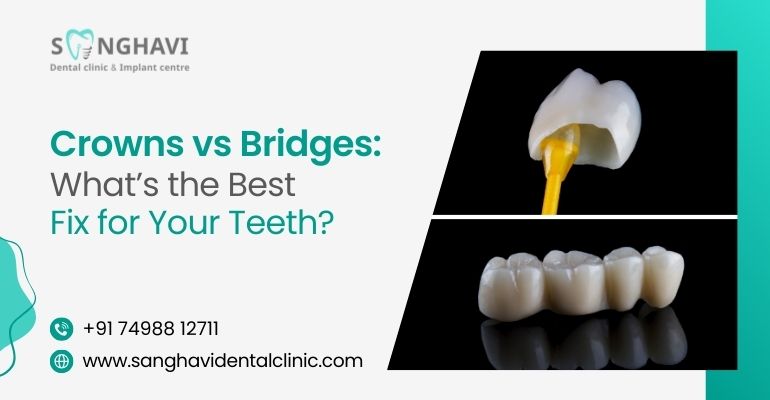
Ever looked in the mirror and noticed a missing or damaged tooth? Maybe you’ve found yourself avoiding big smiles in photos or chewing on one side to prevent discomfort. Many people face the same issues: Should I go for a dental crown or a bridge?
We know it can feel confusing, but don’t worry. By the end of this blog, you’ll have a clear idea of which option might be the best fit for your smile. Let’s break it down!
Understanding the Basics: What Are Crowns and Bridges?
Before we discuss which option suits you best, let’s quickly cover these treatments.
Dental Crowns: The "Cap" for Your Tooth
A dental crown is like a helmet for your tooth. It covers a damaged, weak, or discolored tooth, restoring its strength, shape, and appearance. Crowns are often used when a tooth is cracked, severely worn down, or after a root canal. They help reinforce the tooth and prevent further damage.
Think of it this way: If your tooth is a house with a weak roof, a crown is like putting on a brand-new, strong roof to keep everything protected inside.
Dental Bridges: Filling in the Gaps
A dental bridge is a solution for missing teeth. If you have one or more teeth missing in a row, a bridge can "bridge" the gap by anchoring onto the neighboring teeth with crowns. The middle part, called a pontic, fills the space where your tooth used to be.
Imagine missing a book on a shelf. A bridge is like inserting a perfectly sized book to keep your shelf (your smile) looking complete and functional.
Which One Is Right for You?
Now that you know what they are, how do you decide which one you need? Here are some key factors to consider:
1. Are You Trying to Repair or Replace a Tooth?
- If you still have the tooth damaged or weak, a crown is the way to go.
- A bridge is likely the better solution if you miss a tooth entirely.
2. How Many Teeth Are Affected?
- Crowns work best for single-tooth repairs.
- Bridges are ideal when you have one or more missing teeth.
3. What About Durability?
- Crowns are incredibly durable and can last 10-15 years with proper care.
- Bridges are also long-lasting but rely on the surrounding teeth for support. The bridge’s stability could be affected if those teeth aren't strong.
5. How’s Your Oral Health?
- The neighboring teeth must be strong enough to handle the extra pressure to support a bridge.
- Individual crowns or dental implants might be better if your adjacent teeth are weak.
What About the Procedure? Is It Painful?
Many people worry about discomfort during dental treatments. But the good news is that crowns and bridges are relatively painless procedures. Your dentist will use local anesthesia to numb the area so you won’t feel a thing.
Typically, both treatments require at least two visits:
First Visit: Your dentist will prepare your tooth (for a crown) or the neighboring teeth (for a bridge), take impressions and find a temporary solution.
Second Visit: Your permanent crown or bridge will be placed and adjusted for a perfect fit.
You might feel mild sensitivity post-procedure for a few days, but this is completely normal and fades quickly.
Take the Next Step Toward a Confident Smile
If you’ve been hesitating to fix your tooth, now is the time to take action. Your smile is one of the first things people notice about you, and a healthy, complete set of teeth can boost your confidence tremendously.
Book a consultation with Sanghavi Dental Clinic & Implant Centre today!